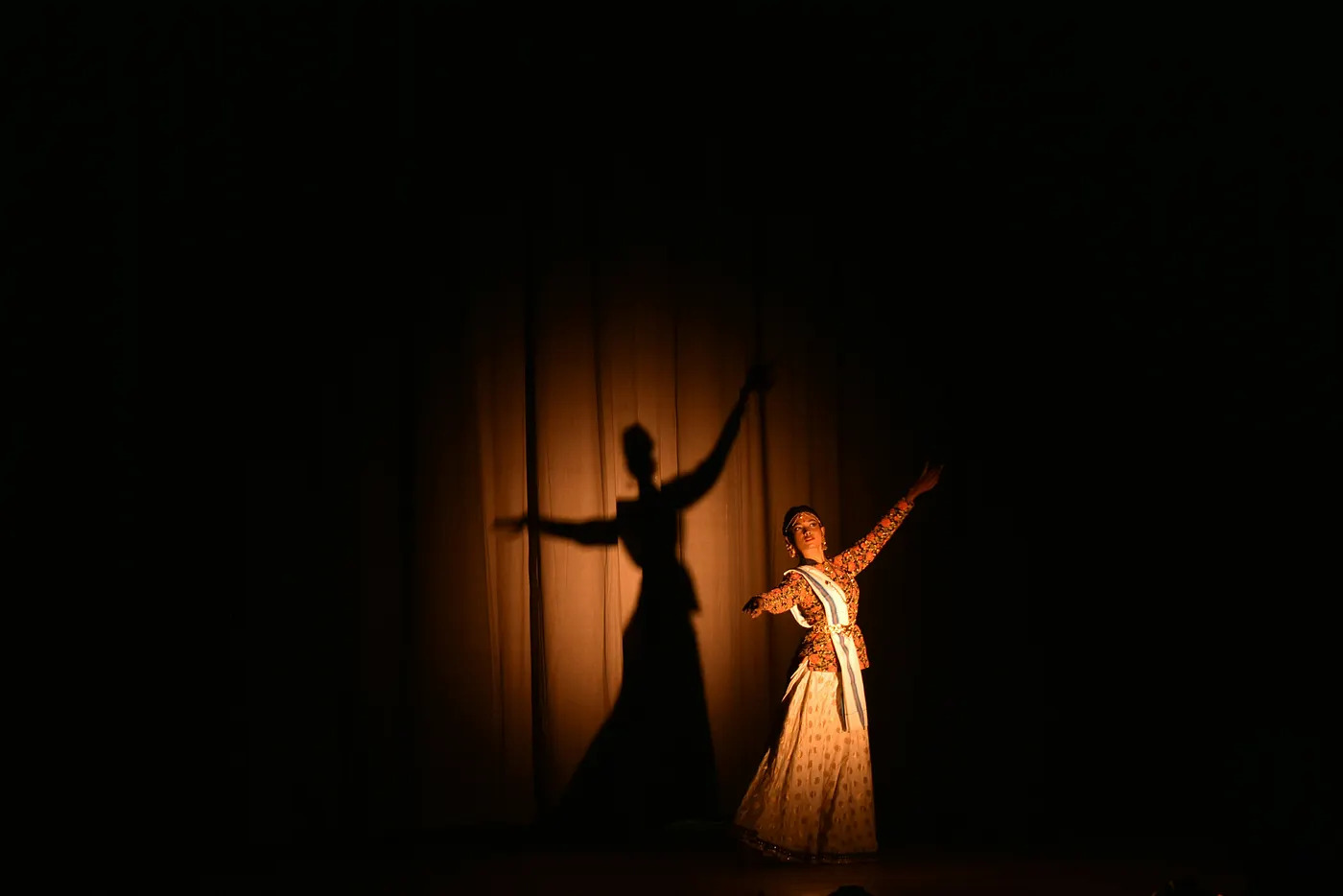
How to Choose the Right Kathak Gharana Before You Begin Training
Sharing everything I learned about all four Kathak lineages, so you don’t have to figure it out alone
When I decided to learn Kathak, choosing a gharana was my Sophie’s choice moment.
My starting point was watching videos of each gharana. I thought it would help, but if only.
Lucknow gharana dancers are so graceful and elegant. The more videos of their performances I watched, the more I wanted their softness and delicate grace.
But when I saw the feisty footwork and vigorous spins of Jaipur gharana, they looked like dancing warriors, so agile and flowy at the same time. Now I was tempted to become a dancing warrior too.
And then, when I watched Sitara Devi ji’s footwork and performance from the Banaras gharana, nothing mattered to me anymore.
The confusion was real.
If you clicked on this article, you’re probably going through the same spiral I did two years ago. And if you still haven’t figured out which gharana suits you, read on, this is for you.
What Are Gharanas in Kathak?

Gharana is derived from the Hindi word ghar, meaning “house” or “family.”
There are schools of thought in every field, right? Be it culture, philosophy, or academics. Likewise, classical Indian music and dance also have their own systems of tradition.
In Kathak, a gharana refers to a unique school of thought, or more precisely, a dancing lineage.
The unique style and technique of each gharana are passed down from gurus to their disciples. For decades and generations now. Thanks to this living continuum, I get to learn Kathak today.
When we talk about Kathak, we’re really looking at four main gharanas: Lucknow, Jaipur, Banaras, and Raigarh. Each was developed in a different royal court. Had varying forms of patronage and, as a result, different artistic priorities.
Key Differences Between Kathak Gharanas

Lucknow Gharana
They are the softest and most graceful gharana.
The court culture here places elegance on the throne. So naturally, they are all about delicate movements and emotional depth. None of their movements feels rushed or exaggerated. And their emphasis is on abhinaya. They slowly reveal their expressions through their soft hands and even softer glances.
In Lucknow style, you’ll notice gentle, inward footwork, powerful but never aggressive. Most of their performances are rooted in devotion and romantic emotion.
So if you are someone who loves grace and softness, Lucknow gharana is your home.
Jaipur Gharana
This gharana is all about power.
The dominant emotion is Veera rasa, the rasa of heroism.
As a new student, I always wondered, “Why is only this gharana so ferocious?” It has grace, absolutely, but its movements and spins are more fierce than those of other gharanas.
I dug and learned that Kathak was first performed in temples, less as entertainment, more as an act of worship. Back then, devotion for some was gentle and soft. For others, it was power and intensity.
The Jaipur gharana was developed under the Rajput rulers of Jaipur. It naturally carried the energy of warriors.
When your audience and primary patronage is the King and his court, performances are inevitably built around the fighter’s spirit, courage, physical mastery, and honor.
That’s why Jaipur dancers are known for their mathematical precision with taal, their thunderous footwork, vigorous spins (chakkars), and their mastery of complex rhythmic compositions, layakari, the hallmark of this gharana.
This is the gharana I am currently learning, and I’ll admit, I am still nowhere close to getting a complete hold on layakari. It keeps me humble on most days. But that challenge is precisely what I can’t let go of.
Banaras Gharana
This gharana houses calm and devotion.
It is mainly about internalization.
The performances are not done to impress or charm the audience. It is more towards worship. That doesn’t mean the audience doesn’t matter. They are invited, but it is less about them and more about connecting with oneself.
Also, this gharana was my first choice. Because I am all about experiencing and expressing something inward. When I dance, it is usually an invitation to myself and others, “Come, enter this inner space with me.”
And the performances in this gharana match that vibe. They often carry a folk-like warmth, a rawness that feels less courtly and more spiritually alive.
Oh, and if this wasn’t already cool enough, this gharana has its own rhythmic language: Natwari bols. So cool, right? It’s distinct from the standard ta -thei -tat vocabulary.
It makes me a little sad, as a dancer, that Banaras is not as mainstream as the other gharanas in Kathak education. But I think this is the true essence of this gharana, right? To simply be. A state of being disciplined and going about life as the inward journey it is.
Raigarh Gharana
This is the rarest of them all.
It’s a gharana consciously built on fusion and experimentation. And believe it or not, it was formed by an Indian king.
Raja Chakradhar Singh of Raigarh (present-day Chhattisgarh), the founder of this gharana, apparently invited maestros from the other three gharanas to his court. And it was not just to chill over a cup of chai and some namkeens. Not quite your Indian royalty version of Bridgerton’s afternoon tea.
He invited them so that he could study Kathak deeply. The king was just like us, you guys, a dance nerd. He learned everything from the pros and even went on to contribute new bols (the mnemonic syllables used in Kathak compositions).
And he didn’t stop there.
He also introduced chakkardaar parans, a contribution that is now a permanent part of Kathak’s vocabulary. And today, when I get to learn this from my gurus, a tradition handed down through dance royalty, mind you, by the king himself. It’s something I’m still taking in.
This gharana is sometimes considered more of a style within Kathak rather than an independent school, mainly because Raigarh does not have the centuries-long, single-family lineage of the other three.
But for me, it stands as an independent gharana.
I couldn’t care less if the argument is that it is court-created and collaborative in origin. There is a lineage, isn’t there? And the guru-shishya parampara of this gharana is very much alive. I think these two reasons suffice.
Which Kathak Gharana Is Right for You?

Dance is all about moving your body naturally to rhythm.
That is why you will hear most dancers say, “Just feel the groove,” not “Dance to the groove”; the dance comes later. It is a response. First, feel it.
Then comes tempo and music. Which one do you usually like to dance to? Slow songs that bring out grace, or fast beats that set your dancing engine alive?
The same logic applies to choosing a gharana.
Based on this, my first choice was actually the Banaras gharana. But in my city, most academies specialize in Jaipur and Lucknow. And Jaipur gharana ranked second on my list anyway, so I signed up for it.
So the second factor to consider is access to quality mentors and dance academies.
I may not have gotten the gharana I initially wanted, but I didn’t settle when it came to choosing the academy. I am super picky when it comes to mentors. Distance and cost, within reason, don’t deter me. I will travel the miles and pay the price, but I want to learn from the best.
Because the best teachers share one quality you won’t find everywhere, patience for the art itself. Their priority is a strong foundation, not stage performance. They teach students to become great dancers, not just performers, and that is what I personally seek.
And if you are already clear on your goal, then the path is easier. Let’s say you are passionate enough to pursue Kathak to become a certified dancer (I already adore you). This depends mainly on one thing, exam curriculum. And the most structured syllabi to lean toward are Lucknow or Jaipur.
And if performance is your goal, you’ll find plenty of mentors and audiences for Jaipur and Lucknow. For Banaras, finding a trained guru may require more searching, depending on where you live.
It All Starts and Ends With You

This is what I eventually learned…
You can begin your Kathak journey by understanding these gharanas, but there is no immediate pressure to choose one forever. Flexibility is one of the beauties of the arts.
Many professional dancers go on to study more than one gharana. However, understanding their identities helps you appreciate the nuances of each style and also reveals where you might naturally belong.
Grateful you made it to the end. If my words resonated and left you better than they found you, I’d love to hear from you.
Stay kind. Stay real.